


Assesing your own dog
Jaws: Upper and lower jaw stong, broad and of equal length, well developed, regular and complete toothing, scissor or pincer bite.
Normally close fitting undershot mouth without any space between the lower and the upper incisor is acceptable. Absence of PM1
(premolar 1) and of M3 is also tolerated. – See full explanation under 'Teeth' elsewhere on this website. Once again it is important to note that jaw and teeth should be strong and well developed, as this is the 'tools' that St. Bernards needed to do there work. With a weak jaw, and small teeth it won't be able to resque humans.
Eyes: Of meduim size, dark brown to hazel, set slightly deep (consequance of the great development of the frontal sinuses) and of friendly expression. The color of the iris should be the same as the darkest color of the mantle (excluding the mask).
It is better if present a natural marking of the eyelid rim with a slight angular fold towards the inner angle of the lower lid. The haw of the lower lid has to show -though not exaggeratedly. Slight angular fold of the upper lid is permitted. Eyelid rims should entirely pigmented, -regarless of the mask (facial markings).
The furtherst part of the triangle of the ear should be in line with the eyes whilst also forming a straight line with the top part of the head.
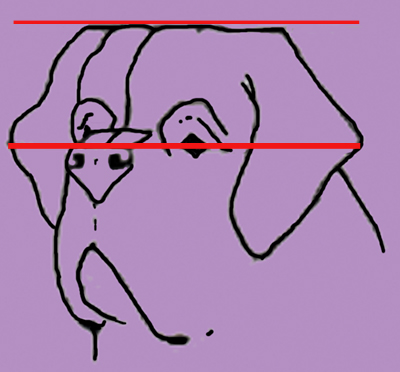
The expression of the eye is very important. Should have an almost dreamy, friendly and intellegent 'look'. Particularly females should have a very tender expression.
Note: sometimes Saints are advertised as 'special' due to having blue eyes. Note that this is disqualifying fault, as may result in health issues. Do not fall pray to this!!!
Ears: Of meduim size, ear-set wide and high; strongly developed burrs. Ears have a triangular shape. The front edge of the flap should lie close to the cheeks, the rear edge may slightly stay off. This will give the impression that the head is somewhat wider then it is. When the dog is alert, the upper sides of the head is formed by the ears, which is then slightly raised.
Neck: Stong and rather long, throat and dewlap moderetely developed. In reality the neck looks quite short, but it is equal to the total lenght of the head.
Body

Profile of the correct alignment:
* An imaginary vertical line drawn from the tip of the shoulder to the ground should reach the tip of the toes.
* An imaginary vertical line, that intersects the centre of the elbow, should devide the limb roughly in almost 2 equal parts -the front part being somewhat larger, and touch the ground just behind the feet.
* An imaginary vertical line drawn from the shoulder to the ground, must devide into 2 equal parts the forearms, wrists, and feet.
* The lenght of the front limbs and the elbow should be equal to half the lenght of the dog (at the withers).
* An imaginary vertical line, drawn from the backside (justbehind the hanging tail), to the ground, should meet the tip of the toes from the hind legs.
* An imaginary horisontal line alongside the backside (that should be straight), and crossing the imaginary vertical line from the shoulder, should indicate where the head should sit…
On top and in front of this line, as indicated below:

Back: Broad, strong and firm. Topline profile is straight and horizontal al the way to the loin. The back also seems quite long, and should be very wide as well (also a feature that lack in alot of pet-saints in SA).
Chest: Brisket moderately deep with well spring rubs. It must not project below elbow level. Costal arch is well rounded never resembling the barrel-chape. Belly and underline slightly tuck up towards the rear. Once again the chest helds the 'factory' in which the Saint (as a working dog) is driven, thus it should be sufficianlty developed.
Tail: Tail-set broad and powerfull. The tail is long and heavy; the last caudal vertebra should reach at least the hock joint. In repose it hangs straight down, gently upturned in the lower third; in exitement carried higher. It should never be carried curled over the back (serious fault), although puppies do this sometimes. It should never be done in adulthood though.
Shoulder: Shoulder blades slope, muscular and firmly clinging to the chest wall. Thus should be extremely muscular. It's lenght from the shoulder blade to the top of the withers, should be roughly 26% of the dog's height. The angle made by the shoulder blade, to an imaginary horisontal line is roughly 45°.
Forearms and upperarm: The upperarm is longer than the shoulder blade, and the angle not to blunt. Straight, with a strong bone structure. Elbow long and prominent.
Alignment is important as one would not want in or out-turned elbows, as this would result in 'north-south' feet set, which is totally unacceptable. Forarms itself should be totally vertical.
Wrists: Should be sharp, wide, thick and totally vertical as the forearms. In puppies and young dogs (up until 1 year and even later in males) the wrists is rather big in comparison with the puppy itself, but it's because of the growth that still needs to take place. In adulthood it is in porportion.
Feet: Broad, tight, strong toes with rather high knuckles and snug toes. Feet also should not be naturaly placed 'north-south' but straight to the front.
Back limbs
From the front should look straight and paralell. An imaginary vertical line from the buttocks should touch the tip of the toes.
Thighs: Strong muscular and broad. Lenght of the thigh should be about 33% of height at withers. The angle formed by an imaginary horizontal line measured 60° and upwards towards the croup is around 106° .
Unaccebtable should be short, flat thighs. Unfortunately alot of pet Saints in SA looks this way.See scetch below. This is what a Saint should NOT look like.

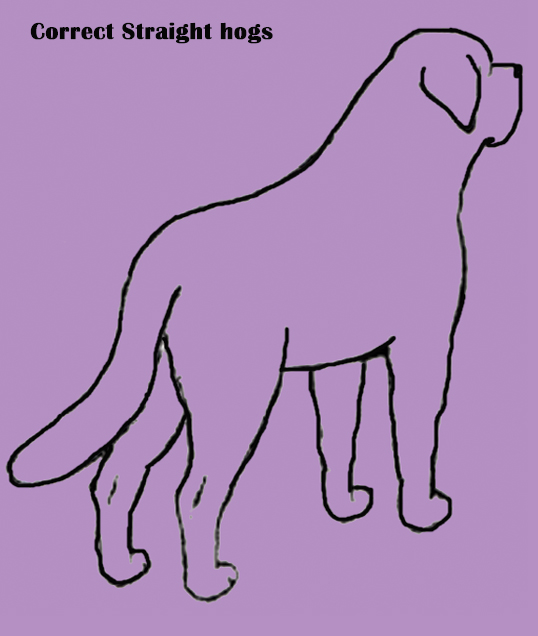
Hocks: Firm and moderaely angulated. Unfortunately no exact measurements are stipulated in the standard, and thus alot of times, hogs tend to be much to straigh (due to interpretation). A better description should thus be 'meaningly' angulated. Thus a 'tad' more then 'moderate'. The height of the 'hock' (from the sole of the foot), should be about 27% of the dogs height. Considered as faults are cowhock (feet turned outside, and hocks inside), as well as toed in dogs. Thus hocks turned outwards causing feet to turn inwards. -see picture below:
Metatarsus:(the part before the knee to the foot) should not be to long, and perpendicular to the ground, viewed from the back or side. Sometimes dogs have dewclaws on the inside that might be surprisingly big. It's advisable to be removed around 3 days after birth as it can hinder movement quite alot in adult hood. The toenail on this 5th toe (dewclaw) also tends to grow back, and can cause serious pain.
Feet: Broad, close with strong toes, with rather high knuckles. Slightly less rounded then the front and less arched.

Profile of male vs female:
